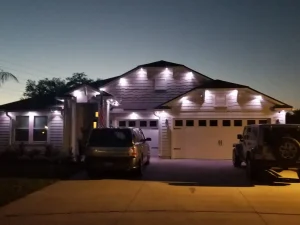
Living near the ocean is hard on anything mounted outside. Salt settles on every surface, the air stays damp for months, and storm season brings wind and driving rain. So it is fair to ask whether permanent lights hold up on a coastal home, and what it takes to keep them looking good. The short answer: a sealed, well-rated system that is mounted properly copes well, and a little routine care keeps it that way. Here is what each part of a coastal climate means for your lights.
- What Salt Air Does to Outdoor Lighting
- Why Humidity Is the Quiet Problem
- Getting Ready for Storm Season
- How the Install Makes a Difference
- Simple Care for Lights Near the Coast
- Frequently Asked Questions
What Salt Air Does to Outdoor Lighting
Salt in the air does not stay in the air. It lands as a fine film on the house, the windows, the car and every fixture outside. Mixed with moisture, it attacks exposed metal, loosens cheap fasteners and works its way into any joint that is not sealed.
That is why holiday strings and bargain fixtures often look tired after a short time near the beach. Exposed sockets corrode, plastic clips turn brittle in the sun, and connections that were never meant to live outside year round start to fail.
Permanent lights take a different approach. The lights sit inside a slim aluminum track mounted along the trim, and the wiring runs inside the track instead of hanging in the open. Fewer exposed parts means fewer places for salt to build up. The Gemstone Lights we install use a powder-coated aluminum track.
No outdoor product is immune to salt, so care still matters. The difference is that a sealed, enclosed system gives salt far less to work on than a string of exposed bulbs.
Why Humidity Is the Quiet Problem
Rain gets the attention, but humidity is often what shortens the life of outdoor lights on the coast. Damp air finds its way into any fixture that is not sealed, then condenses inside when the temperature drops overnight. Over time that moisture fogs lenses and corrodes contacts.
This is where a fixture’s ingress protection rating, or IP rating, matters. The first number describes protection against dust and the second against water. Gemstone’s spec sheet rates its lights IP67, which means dust-tight and protected against temporary immersion in water. That is a stronger rating than you need for rain alone, and it is what you want in a place where the air itself is wet for much of the year.
The connections matter as much as the lights. A sealed light on an unsealed joint still lets moisture in. When we install, we pay attention to every connection along the run and at the controller, because that is where moisture problems usually begin.
Getting Ready for Storm Season
Storm season is the other big question near the coast. Permanent lights are mounted tight to the trim along the roofline, with no loose strings to whip around in the wind or tear free. In ordinary storms, a well-mounted system simply rides it out.
Major storms are a different matter for every part of a home. No exterior fixture can be promised to survive every hurricane, and if the trim or fascia it is mounted to is damaged, the lights on it will be too. After a big storm, walk around the house in daylight and look along each run for any section that has shifted or been struck by debris, and contact us if anything looks out of place.
Before a storm, there is nothing special to take down. If you lose power, the lights simply go off with everything else. Once power is back, check that the controller has reconnected and that your schedule is still running in the Gemstone Lights app.
How the Install Makes a Difference
On the coast, the quality of the install matters as much as the product. A good system mounted carelessly will not last as long as it should. The track has to sit straight and secure along the trim, the runs have to be planned so connections are protected, and the controller has to be placed somewhere sheltered.
We start with a visit to walk through the options and the steps with you, and we look at the condition of the trim and fascia before planning the runs. Sound trim gives the track a solid base. If a section of trim is already soft or damaged, we point it out so it can be dealt with first.
The same care applies to every part of the home we light, from trim lighting along the roofline to runs under the eaves with our soffit lighting installation. Screened pool enclosures face the same salt and damp, and our pool cage lighting is planned with that in mind.
On warranty, Gemstone publishes its warranty terms on its own website, and we go through them with you before you commit.
Simple Care for Lights Near the Coast
Permanent lights do not need much attention, but a little care goes further near salt water. Most of it you can do from the ground.
- When you rinse the house or windows, give the track a gentle rinse with fresh water too. That washes off salt before it builds up.
- Skip the pressure washer on the lights. A garden hose is enough.
- Look along the runs a couple of times a year, and after any big storm, for sections that have shifted.
- Keep the controller area clear of plants and debris so it stays dry and ventilated.
- If a light or section stops working, contact us rather than opening the track yourself.
Do not climb up to the roofline to clean the lights. Anything that needs a ladder is a job for us.
If you live near the water and want permanent lights that are planned for salt, damp and storms, get in touch with M2 Accents. We visit the property, walk you through the options and the steps involved, and then send a quote. We work with homeowners in St. Augustine, Vilano Beach and nearby.
Frequently Asked Questions
Do permanent lights hold up in salt air?
A sealed system in an aluminum track copes far better than exposed strings, because there are fewer open parts for salt to attack. An occasional fresh-water rinse helps keep salt from building up.
What does IP67 mean?
It means the light is dust-tight and protected against temporary immersion in water. Gemstone’s spec sheet gives its lights this rating.
Do I need to take the lights down before a hurricane?
No. The lights are mounted tight to the trim with no loose strings. After a major storm, look along each run in daylight and contact us if a section has shifted or been damaged.
Can I pressure wash the lights?
No, use a garden hose instead. A gentle fresh-water rinse removes salt without forcing water at the connections.
What happens to my schedule after a power outage?
The lights go off with the power. Once it is back, check in the Gemstone Lights app that the controller has reconnected and your schedule is running.
Where can I read the warranty terms?
Gemstone publishes its warranty terms on its website, and we walk you through them before you commit.