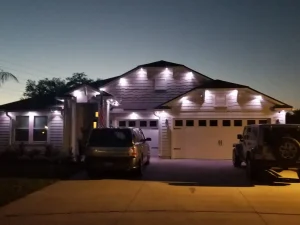
Most homes are lit from one direction: a fixture by the front door and maybe a floodlight on the garage. The result is a house that looks flat after dark, with bright patches and deep shadows in all the wrong places. Lighting designers work with three basic tools instead: uplights, downlights and wall washers. Once you know what each one does, choosing where to uplight and pairing it with light from above gets much easier.
- Uplights: Drama From the Ground
- Downlights: Soft Light From the Eaves
- Wall Washers: Even Light Across a Surface
- Matching the Light to the Feature
- Bringing the Three Together
- Frequently Asked Questions
Uplights: Drama From the Ground
An uplight sits at or near ground level and points upward. Because the light travels up a surface, it stretches shadows and makes features look taller and more sculpted than they do in daylight. That is why uplighting is the go-to choice for trees, columns, stone and anything with height or texture.
Palms are a natural fit. A light set at the base and aimed up the trunk picks out the texture of the bark and lights the fronds from beneath, so the tree stands out against the night sky. Oaks and other spreading trees usually look better with more than one light, set out under the canopy and aimed back in, so the whole crown glows rather than a single stripe up the trunk.
On the house itself, uplights work well on columns, stone chimneys and the corners of a facade. Placed close to the wall and angled steeply, they graze the surface and bring out every ridge of stucco or stone. Uplights are part of landscape lighting, and placement matters: aim them so the beam stays on the feature and does not shine into windows or a neighbor’s yard.
Downlights: Soft Light From the Eaves
Downlights do the opposite job. Mounted high and pointing down, they cast light the way the moon or the sun does, which looks natural and keeps glare out of people’s eyes. They are the best tool for lighting entries, walkways near the house, and the ground around a patio.
The eaves are the obvious place for them. Lights tucked into a slim track under the soffit sit out of sight from the street and throw a soft pool of light onto the walls and ground below. Run along the front of the house, they light the entry, the garage approach and the landscaping in one pass.
Our soffit lighting installation uses this approach. Because the lights sit high, a run of them covers a wide area without the harsh hot spot of a single floodlight. Downlights also pair well with uplights: light from below shows off a feature, and light from above makes the space around it usable.
Wall Washers: Even Light Across a Surface
A wall washer spreads light evenly over a broad surface. Where an uplight grazes and creates texture, a washer sits farther back from the wall and floods it with smooth, even light. The effect is calm and architectural, and it is the right choice when the wall itself is the feature: a painted facade, a long garden wall, or the side of a home facing the street.
The difference between grazing and washing comes down to distance and angle. Close and steep shows texture, which suits stone and rough stucco. Farther back and wider shows color and form, which suits smooth paint and siding. On many homes the best result uses both: grazing on a stone base and washing on the painted wall above it.
A run of downlights along the eave can work as a wall washer too, because each light spreads across the wall below it. That is one reason architectural lighting often starts at the roofline: it lights the shape of the house and the walls in one system.
Matching the Light to the Feature
The simplest way to plan is to list what you want people to notice from the street, then pick the tool for each one.
- Palms and specimen trees: uplights at the base, more than one for wide canopies.
- Columns, chimneys and stonework: uplights close to the surface to graze texture.
- Entries and porches: downlights from the eave above.
- Smooth painted walls: a wash from farther back, or a run of eave lights.
- The roofline itself: an outline that follows the edges and peaks.
For the roofline, trim lighting traces the edges of the house so the shape reads clearly from the road. On homes with a screened pool area out back, the same thinking applies to the enclosure frame, which our pool cage lighting page covers.
Leave some areas dark. A property where every surface is lit looks flat again, just brighter. Shadows between lit features are what give a nighttime scene depth.
Bringing the Three Together
The best-looking homes at night use all three tools in balance. Uplights give height and drama, downlights give soft, usable light, and washes tie the walls together. The key is that no single layer overpowers the others.
Color is part of that balance. Warm white suits stucco, stone and most painted finishes, and it matches the tone of typical porch fixtures. Permanent eave and trim lights from Gemstone Lights add another option: Gemstone says its lights can show over 16 million colors, so the eave layer can run warm white most nights and switch to color for holidays and events from the Gemstone Lights app.
Control matters too. When the uplights and the eave lights come on at the same time, the house appears as one finished scene at dusk. We plan the layers together so they work as a single system.
If you are weighing ideas for the outside of your home, get in touch with M2 Accents. We visit the property, walk you through the options and the steps involved, and then send a quote. From uplights on the palms to permanent lights along the eaves, we plan the whole picture with you, for homes in St. Augustine, Vilano Beach and nearby.
Frequently Asked Questions
What are good exterior uplighting ideas for a home?
The strongest ideas are uplighting palms and specimen trees from the base, grazing columns and stonework from close in, and lighting the corners of the facade. Pair them with downlights from the eaves so the space around each feature is lit too.
What is the difference between an uplight and a downlight?
An uplight sits low and points up to add height and drama to a feature. A downlight sits high, usually under the eave, and points down to give soft, natural-looking light on walls and the ground.
What is a wall washer?
A wall washer spreads light evenly across a broad surface. It sits farther from the wall than a grazing uplight, so it shows color and form instead of texture.
How many uplights does a palm tree need?
Often one, aimed up the trunk, for a single tall palm. Clusters and wide trees usually need more, and we decide the number on site after seeing the tree from the street.
Can eave lights change color?
Yes, with permanent lights such as Gemstone Lights. They can run warm white every night and switch to color for holidays and events from the app.
What happens after I get in touch?
We schedule a visit, walk you through the options and the steps, and then send a quote. Once you are happy, we book the install date.